
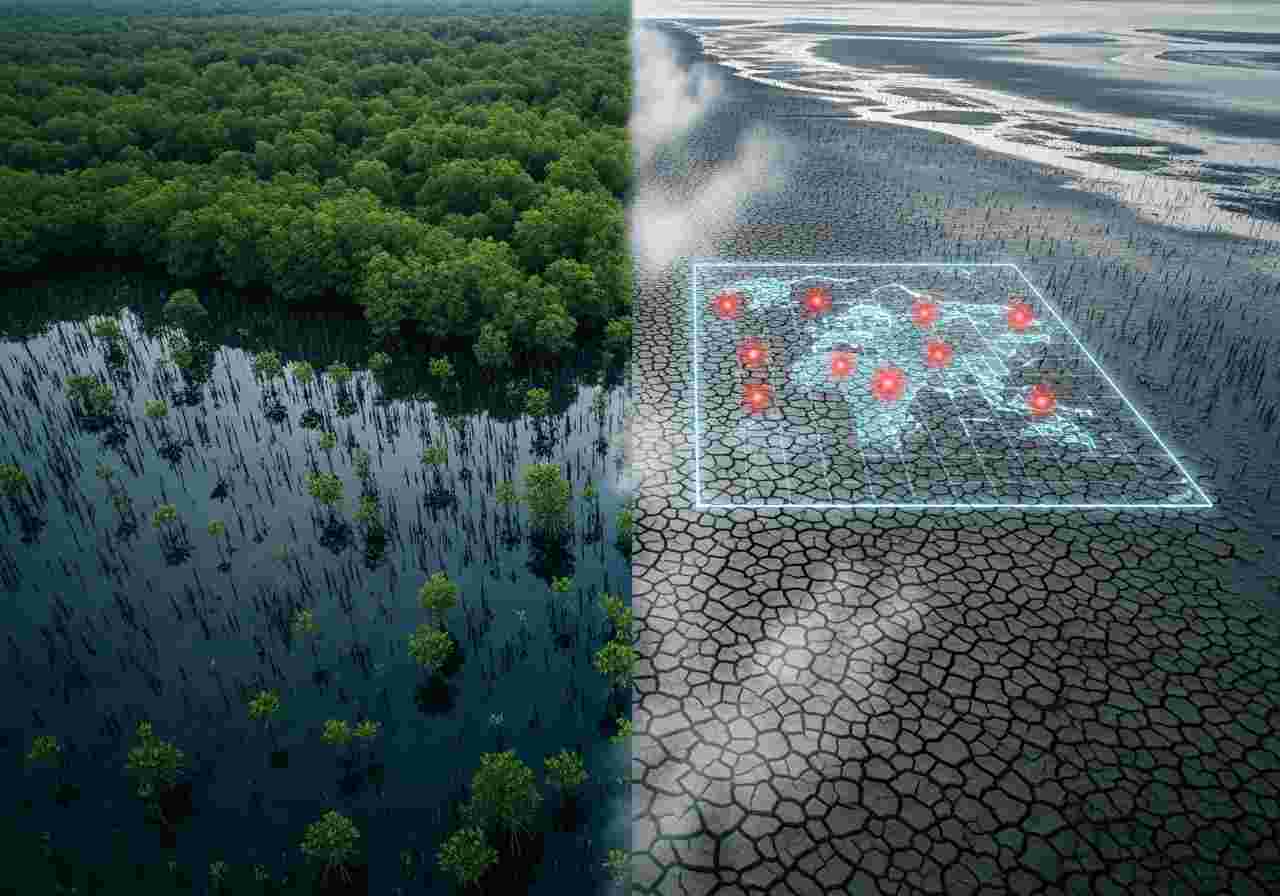
The secret banking system of the planet. These vital vaults have been ecosystems such as peatlands and ancient forests that have been in existence over millennia. However, a beautiful new find reveals that people are plundering these areas. Scientists are now revealing high-resolution maps to the world, which show the rapid disappearance of what they term irrecoverable carbon. This isn’t just about trees. We cannot spare this legacy carbon, which ecosystems have built over centuries.
The statistics are a desperate image. When this carbon gets into the atmosphere, we would not be able to capture it before it reaches the atmosphere so as to achieve our 2050 climate targets. This fact changes the whole conservation debate. We do not guess anymore where to defend. It is like sailing by a very inaccurate, frightening ledger.
The definition of Irrecoverable Carbon
Let’s be clear. This is no carbon in the seasonal leaves of a sapling. The long term savings of the planet is irrecoverable carbon. It is the thick and old biomass of the old-growth trees. It is millennia of the organic matter in the waterlogged peat soils. This carbon is locked away. It does not cycle quickly.
The moment it comes out, it is no longer in our working time. The nature cannot undress it in time. This finding puts a new meaning to our priorities. It is necessary to save things, not only to repurchase lost things.
This is the carbon, and we cannot get it back. It is the disparity between the library of old priceless manuscripts and a pile of the current day newspapers.
This also describes the condition of the United States, where significant efforts have been undertaken to enhance spatial planning in the nation’s most populated regions.<|human|>This is also the state of the United States, where serious attempts are made to improve spatial planning in the most populated areas of the country.
The New Discovery: A High-Res Planetary Triage Map
The current advances in LiDAR and satellite spectroscopy have produced a revolution. We are now able to view carbon density, as opposed to green space. This finding enables scientists to identify a primary forest in good health, where there is a lot of carbon, and the primary forest that is regenerating, which is younger. The map is a triage tool. It indicates the exact locations of the crucial fights.
The analysis identifies 139 billion tonnes of this irreversible carbon in the world. That figure is staggering. It has the same amount of emissions of global fossil fuels in 15 years. This information makes abstract risk real, a crisis, which is mappable.
Case Study The Congo Cuvette Centrale -A Ticking Clock
Examine the Cuvette Centrale of the Congo Basin. It is the largest complex of tropical peatland in the world. This one ecosystem has approximately 30 billion tonnes of carbon. That is approximately three years of the worldwide fossil fuel production. During centuries, it has changed not. Now, it faces new threats.
This is a critical area that is currently overlapped by the oil and gas exploration licenses. The process starts with agriculture drainage. This is a wake-up call because it has been discovered that this is a threat. This is one region that needs protection through global climate. A collapse would be disastrous to it.
Domino Effect: Not Only Loss of Carbon
The crisis is much further than the air. These carbon dungeons are as well biodiversity hot spots. They are the habitats of myriads of species that are not found anywhere. In addition, they serve crucial services to humanity. They control freshwater and prevent storms along the coastline.
More importantly, Indigenous communities are actively conserving most of these landscapes. Their experience is the secret to their defense. A finding in the Brazilian Amazon demonstrates this. Indigenous territories significantly reduce deforestation rates.They are the best protectors of the vault.
An Original view: The ‘Carbon Tipping Point’ Theory
An important insight is provided by Dr. Maya Singh, an ecologist who had contributed to the Nature Sustainability* study. She refers to it as the theory of the Carbon Tipping Point. She says that ecosystems do not necessarily go down on a linear model. They may be stationary until a particular level is reached.
Think of it like a levee. It is long lasting in its ability to sustain increasing water. However, when one crack is created the whole structure collapses. Our new maps make us see the cracks that are being made. It is now possible to forecast the nearest levees. It is possible to prevent this discovery.
The Future: Between Data and Defense
Now then what of this urgent discovery? To begin with, we should make these maps part of the national climate commitments. Policy must follow the data. Second, the carbon finance should be directed to those communities at the frontline. We need to fund guardianship.
Lastly, the corporate supply chains are to be transparent. It must be demanded by the consumers and investors. We cannot permit the products to get into the market associated with destruction of these vaults. The solution also presents itself in the discovery of the problem. It involves urgent concerted efforts.
Introduction: The Ballast of Our Planet
This is not a new finding that can be ambiguous. We have the maps. We have the data. The silent crisis has now turned into a screamer. These are the ecosystems that form the ballast of our climate. They offer security on the whirlwind of change.
Their loss does not only postpone our development. It threatens to shipwreck the whole ship. The choice is ours. Shall we endanger our future generations with the life-sustaining riches of the past? This is one decisive question that determines the stability of our future. The discovery has been made. The next move is ours.