
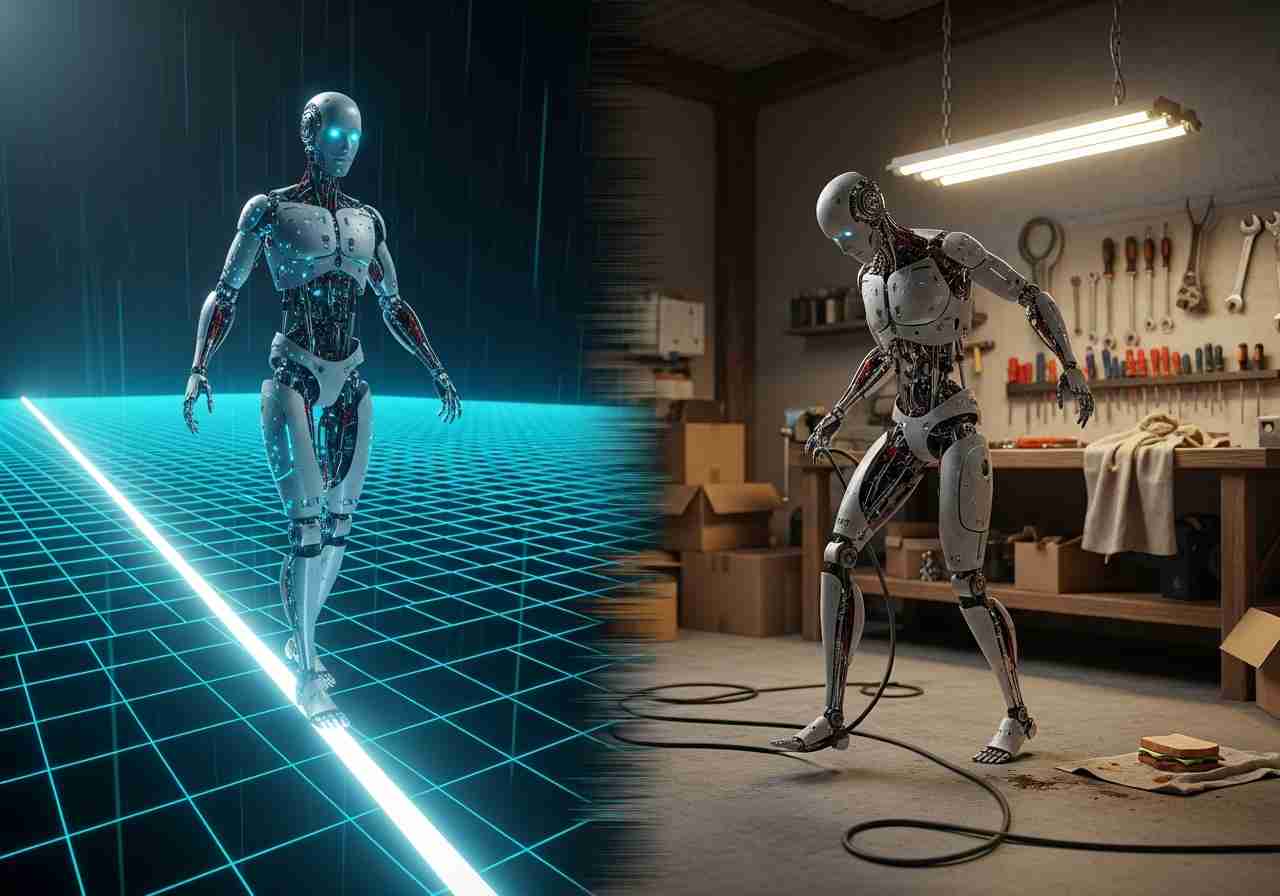
The humanoid simulator robot is an ideal dancer. It leaps into the air in balletic style on a clean digital stage. All its motions testify to perfect code. Now observe its physical equivalent of multi-million dollars in a laboratory. It trips on an electric cable its digital counterpart has never encountered. This, right here, is the brutal reality of the Sim2Real gap.
It is the one most frustrating problem of advanced robotics nowadays. So brilliant in a test, and so wicked in the wild, how can a machine be so brilliant? This is the one that exists between our dreams of sci-fi and the chaotic, unstable reality that we exist in. Now, let us get down to the reasons why this is occurring and what it is saying about the future of AI.
The charisma of the digital dojo
Why is it that we so much depend on simulations? The solution is uncontaminated speed. Thousands of training years can be trained in one day in a simulator. We are able to hit a million times a robot and just have it scratched. It is the driving force of the contemporary AI Robotics development.
It’s also incredibly cheap. There’s no hardware to break. No costly devices to upgrade. It is a kind of digital playground to which we inculcate robots. But it’s a gilded cage. The ideal it can give is an illusion that is harmful.
Where the Illusion Shatters
So what goes wrong? Think how you can spend all your life in a white room. Then you are plunged into a metropolis. The skills learned are almost useless to you on the spot. That’s the robot’s reality. Physics are only a little bit off. Friction isn’t perfect. Materials deform in unusual forms.
“The way in which we understand the world is limited by its models. The impersonation that simulators make is an approximation, and there are repercussions to the approximations,” says Dr. Anya Sharma, an engineer in robotics.
Furthermore, sensors lie. A glare causes the blindness of a camera. An infrared scanner interprets a black floor as a bottomless hole. In fact, these cases of the edge are the norm. They create a prolonged chain of random confusion simulation never can train them to take.
A Gripper’s Tale: A Case Study
Take a real-life test of a Stanford laboratory. A machine was trained in simulation and allowed to pick up a mug. It achieved a 99.9% success rate. The policy was handed over to a physical robot. The rate of failure was horrendous.
Why? The simulated gripper was in a perfectly rigid state. The actual one had soft rubber pads which deformed. The mug simulated was always clean. The actual one was a little oily. The lighting was different. There were microscopic errors of calibration in the arm. Each minor dissimilarity accumulated. The result was total failure. This is the nut shell of Sim2Real problem.
Engineering to Chaos: Fighting Back
The good news? Engineers are retaliating using tricks. Domain Randomization is one of the methods that are powerful. This entails simulation randomization. Alter the surfaces, the light, even the gravitation. This causes the AI to discover an effective policy, not a weak one.
The other method is real-world fine-tuning. You gather some little information out of the physical robot failures. then based on that you make adjustments to the simulation. It is a piece of self-fulfillment that gradually bridges the gap. This process is slow. Nevertheless, it is vital to the development of competent robots.
The Humanoid Robot Problem
This is compounded with humanoid robots. Why? Due to the fact that walking is a controlled fall. Even the smallest mistake in ground friction calculation is a huge faceplant. The intricate mechanics of the bipedal locomotion are so difficult to model.
Boston Dynamics notoriously welcomed the anarchy. Their robots do not merely simulate learning, they learn.
They put their Atlas humanoid robot into test in the real world. They push it, slip it and give it off balance. This actual world data cannot be replaced. It develops a strength that pure simulation is not capable of.
A Better Secret: The Body Counts
The following is a personal observation during a lab. We pay excessive attention to AI brain. The body is an accessory to us. Nevertheless, neural networks are not the only forms of intelligence. It is also within physical design. Shock is better absorbed in compliant materials compared to any algorithm.
Passive dynamics have the potential to help in stability. We need co-design. We should create smarter brains with smarter bodies. The answer is not in a better code. It is a more desirable collaboration between the physical and the digital. This forms the second frontier of AI Robotics.
The Unavoidable Mess
So, where does this leave us? Sim2Real gap is not a bug that should be fixed. It is the principle of reality. We are never going to reproduce our world perfectly in the digital world. And maybe we need not even make an attempt.
The final breakthrough will not involve an ideal simulator. It will be developing AI that will be at ease with incompleteness. We cannot do away with robots which implement a plan. We require them to change, to recover through a fall and to improvise. The future robots will lie in the acceptance of the beautiful unpredictable mess of the real. Are we prepared to create in anarchy?